Sunday, May 1, 2022

The Kip-Kipp Newsletter Volume 1 Issue 2 2022

The Kip-Kipp Family Newsletter

Table of Contents

1. The Kip-Kipp Family Newsletter

2. Edward Kipp, HBSc, PhD, MLS

3. History of The Kip Family in America

4. What do we know about Hendrick Hendricksen Kip the emigrant (Part 2 – 1643 -1685)?

5. Letters to the Editor

6. yDNA study at FT DNA on the Kip-Kipp Families

7. Next Issue


1. The Kip-Kipp Family Newsletter


The second issue of the newsletter has proven to be every bit as difficult as the first. It is just over a year since Edward passed away and I do wonder where that year has gone. Of course we have spent much of it inside with COVID restrictions which I actually welcomed. I prefer the quiet solitude of home life to being out and about. But moving on with the newsletter is important to get all of Edward’s research out in the public forum for others to use and enjoy. 


2. Edward Kipp, HBSc, PhD, MLS


I often think that losing one’s father at the age of two must be an extremely traumatic experience. You do not have the luxury of memory as the day to day incidents are quickly lost although probably hover in the back of the brain and display in unusual ways. Not being a clinical psychologist I have no ideas on that but I am suspicious. I did go to Princeton, Ontario, Edward’s home time quite a few times during our married life and he loved it there but he also loved it that he had achieved his desire as a child to go to University and study Chemistry and complete his PhD. Not being able to find a job that made use of all that training did not defeat him but rather he trained to be a Librarian and spent the rest of his working life as as an Information Scientist at the National Research Council in Ottawa. We had married when he completed his HBsc in 1966 so I got to be around for all of those years of work and then the years of traveling which was one of his joys in retirement years (he was retired 17 years). Watching as a person goes through their life is an honour I always feel. I suspect that I am a watcher rather than a doer mostly but it appears I am also capable of doing genealogical research as well but a late bloomer for sure. Edward started young learning about his ancestors from his grandparents and early in our marriage he started to record all of that information he was acquiring and had acquired in his youth. Being the scientist he was, he verified all of that information which entailed trips to many repositories in Ontario after we bought a car. I wasn’t interested in genealogy but I liked being part of Edward’s team and so did do work on it when he asked. 


3. History of The Kip Family in America


https://wc.rootsweb.com/trees/133965/I1/hendrickhendricksen-kip/individual 


This website on Roots Web is still accessible but the entire listing is also on the website which Edward created:


https://wc.rootsweb.com/ 


In World Connect, search the "jump to a specific database" field for edwkipp8


I need to decide if I should do more with the material in this earlier history. Should I publish parts of it? It is a mystery at the moment as the book is on Internet Archive but there are pictures in the book and presumably they are out of copyright since it was published in 1928 but will check on that. 


Fortunately for the Kip Family in America an earlier researcher put together an extensive family genealogy book “History of The Kip Family in America” by Frederic Ellsworth Kip of Montclair, New Jersey and assisted by Margarita Lansing Hawley of Morristown, New Jersey and was published in 1928 at Boston by Hudson Printing Company. It is available on Internet Archive:


https://archive.org/stream/historyofkipfami00kipf_2/historyofkipfami00kipf_2_djvu.txt 


4. What do we know about Hendrick Hendricksen Kip the emigrant (Part 2 – 1643 -1685)?


Hendrick Hendricksen Kip was likely in New Netherland on the 16 Apr 1643. He witnessed a settlement by Gertruyt Jacobs on her children [New York Historical Manuscripts: Dutch; Vol. II, Register of the Provincial Secretary 1642 – 1647; Translated by Arnold J. F. van Laer (1974), pp. 115 – 116 [original document # 51c]]. This transcription reads as follows:


“Settlement by Geertruyt Jacobs, widow of Gerrit van Vorst, on

her children of their portion of their father's estate

[51c] In the year of our Lord [and Savior Jesus Christ,

one] thousand six hundred and forty-three, [on the 1 6 th] day

of April, before me, [Cornells van] Tlenhoven, secretary in New

Netherland, residing in Fort Amsterdam, appeared Geertruy[t]

Jacobs from Emmenes (a village in the province of Utrecht, near Amersfoort), 

widow of the late Gerrit van Vorst, with

Oloff Stevensen, commissary of the store, and Hendric Kip, tailor,

both residents here, her chosen guardians in this case, who declared

that she intended to enter into the holy state of matrimony with

Rouloff Jansen from Norway, for which reason she promised, as she

does hereby, to pay to both her minor children, Jan Gerrltsen and

Jacob Gerrltsen van Vorst, for their patrimonial estate, when

they shall have attained their majority, to each the sum of seventy-

five guilders; and if it should happen that one of the two children

died before reaching his majority, it is expressly stipulated that

she, Geertruyt, and he, Rouloff Jansen, shall pay to the survivor

as his paternal inheritance a double portion, being one hundred

and fifty Carolus guilders, provided that she, Geertruyt Jacobs,

the present bride, and Rouloff Jansen, the present bridegroom,

shall have the use of the aforesaid money without interest until

the above named children are of full age. They, the bride and

bridegroom, also promise to bring up the children, keeping their

capital safe and not touching more than the interest; furthermore,

that they will rear the children decently, send them to school

and have them taught reading, writing and a good trade, as decent

and God-fearing and honest parent are bound to do, but all accord

ing to their means and no more, doing what [51c (2 )] they may

expect to justify before God and honest men. They Geertruyt

Jacobs and Rouloff Jansen, promise to perform and fulfil this in

whole or in part, without any exception which may in any wise

contravene this, all without fraud, for which they bind their

persons and properties, present and future, without any exception,

subjecting and submitting the same to the Provincial Court of

Holland and to all other courts, tribunals and judges. In witness

whereof this is signed by Geertruyt Jacobs, Rouloff Jansen, and

her chosen guardians, and by me, the secretary, in the record.

Done in Fort Amsterdam in New Netherland the day and year above

written.

Gerttrult Jacop from Eramenis

Rolof Jansen Haes

Hendrick Hendricksen Kyp

Oloff Stevensen

Acknowledged before me,

Cornells van Tienh., Secretary”

Looking at the index there are a number of references to the Kip family (again this is a transcription found on page 507 of the above mentioned Register of the Provincial Secretary transcripted/translated by Arnold J. F. van Laer (1974)):

“KIP

Hendrick Hendricksen Kyp

51c, 60b, 64, 168a, b

Jacob/Jacob Hendricksz

147d, 148f, g, i, j, 149c, d, 150h, i, j, 151c, d, e, f, 152d, 153b, 154c, d, f, j, 157h, 158d, g, k, l, m, o, 159b, e, g, 160a, b, g, h, j, 161a, b, c, d, e, f, 162a, b, c, e, f, g, h, i, m, n, 163a, c, d, e, f, 164d, g, 165a, 166b”

Giving a timeline to these documents (all created in New Amsterdam except those marked with an * and they were at Fort Amsterdam or marked with an a and they were noted as New Netherland or with a b and that is the Island of Manhattan)):

Number Name Purpose Date

60b * Hendrick Kip Power of attorney 15 Jun 1643

64 Hendrick Hendricksen Kijp Witness Marriage Contract 3 Jul 1643

168a a Hendrick Hendricksz Kip Named as Creditor 19 Aug 1647

168b b Hendrick Hendricksen Kyp Witness Bon 19 Aug 1647

147d Jacob Kip Witness Quit Claim ~ 23 Oct 1645

148f Jacob Hendricksz Kip Witness Land Sale 15 Sep 1646

148g Jacob Hendricksz Kip Witness Signature 17 Sep 1646

148h Jacob Kip Witness Signature 18 Sep 1646

148i a Jacob Kip Witness Signature 17 Sep 1646

148j Jacob Kip Witness Signature 17 Sep 1646

149c a Jacob Hendricksen Kip Witness Signature 19 Sep 1646

149d a Jacob H Kip Witness Signature 20 Sep 1646

150h Jacob Hendricksz Kip Witness Signature 18 Oct 1646

150i * Jacob Hendricksz Kip Witness Will Signature 17 Oct 1646

150j * Jacob Kip Witness Signature 18 Oct 1646

151c * Jacob H. Kip Witness Bond 24 Oct 1646

151d a Jacob H. Kip Witness Signature Board 24 Oct 1646

151e Jacob Kip Witness Contract of Sale 24 Oct 1646

151f * Jacob H. Kip Witness Signature 29 Oct 1646

152d Jacob Kip Witness Contract of Sale 24 Nov 1646

153b Jacob H. Kip Witness Deed Transfer 2 Dec 1646

154c Jacob H. Kip Witness Bill of Sale 11 Dec 1646

154d Jacob Hendricksz Kip Witness Sublease 14 Dec 1646

154f Jacob Hendricksz Kip Witness Bond 14 Dec 1646

154j * Jacob Hendricksz Kip Witness Lease 26 Jan 1647

157h Jacob Hendricksen Kip Witness Power of Attorney 19 Jun 1647

158d Jacob Hendricksz Kip Witness Promissary Note 26 Jun 1647

158g Jacob Hendricksz Kip Witness Power of Attorney 2 Jul 1647

158k Jacob Kip Witness Bond 6 Jul 1647

158l * Jacob Kip Witness Signature 6 Jul 1647

158m * Jacob H. Kip Witness Deed Transfer 6 Jul 1647

158o * Jacob Kip Witness Deed Transfer 11 Jul 1647

159b a Jacob H. Kip Witness Signature 17 Jul 1647

159e * Jacob H. Kip Witness Signature 20 Jul 1647

159g * Jacob H Kip Witness Transfer 22 Jul 1647

160a * Jacob Hendricksz Kip Witness Signature 22 Jun 1647

160b Jacob H. Kip Witness Bond 23 Jul 1647   

160g * Jacob Kip Witness Signature 25 Jul 1647

160h * Jacob H. Kip Witness Signature 26 Jul 1647

160j * Jacob Kip Witness Signature 26 Jul 1647

161a Jacob Kip Witness Signature 2 Aug 1647

161b * Jacob H. Kip Witness Signature 2 Aug 1647

161c * Jacob Hendricksen Kip Witness as Clerk 2 Aug 1647

161d * Jacob H. Kip Witness Signature Mark 2 Aug 1647

161e * Jacob Hendricksz Kip Witness Signature Mark 2 Aug 1647

161f * Jacob H. Kip Witness Signature 2 Aug 1647

162a Jacob Kip Witness Signature 2 Aug 1647

162b Jacob Hendricksz Kip Witness Signature Mark 2 Aug 1647

162c Jacob Kip Witness Signature 2 Aug 1647

162d * Jacob Kip Witness Signature 2 Aug 1647

162e * Jacob H. Kip Witness Signature Mark 2 Aug 1647

162f a Jacob H. Kip Witness Signature 2 Aug 1647

162g Jacob Kip Witness Signature Mark 3 Aug 1647

162h Jacob H. Kip Witness Signature 3 Aug 1647

162i * Jacob H. Kip Witness Signature 3 Aug 1647

162m * Jacob Hendr. Kip Witness Signature Mark 8 Aug 1647

162n Jacob Kip Witness Signature 8 Jul 1647

163a * Jacob H. Kip Witness Signature 9 Aug 1647

163c * Jacob Hendricksz Witness Signature 10 Aug 1647

163d * Jacob Hendricksz Kip Witness Signature 10 Aug 1647

163e Jacob Kip Witness Signature Mark undated

163f * Jacob Hendricksz Kip Signed Power of Attorney undated

164d * Jacob H. Kip Witness Bond of Surety 14 Aug 1647

164g * Jacob H. Kip Witness Signature 14 Aug 1647

165a * Jacob Hendricksz Kip Witness Signature 14 Aug 1647

166b * Jacob Kip Witness Signature 16 Aug 1647


Interesting that Jacob is signing as a witness but not Isaac Hendricksen Kip who was 20 years of age. 

The document 163f identifies Jacob Hendricksen Kip as at present assistant in the service on the honorable West India Company here (New Amsterdam) and assigns his uncle Harman Hendricksz Drooch (living in Amsterdam, The Netherlands) as his power of attorney to collect his wages in total three hundred and seventy guilders, seventeen stivers, eight pennies from the Directors of the General Chartered West India Company. 

It is also known from Dutch records that Tryntjen Hendricks (their last child known to be born in The Netherlands) was baptized 8 Jun 1636 in the Oude Kerk, Amsterdam – Noord-Holland, The Netherlands (DTB 007p091). The sponsors were Femmetje Lubbers (perhaps a sister to the mother) and Sara Wiltens. Thus showing their presence still in Holland in 1636. Their time of departing from Europe is unknown. Their arrival date in New Amsterdam is also unknown. 


A further proof of the presence of Hendrick Hendricksz in New Amsterdam on 19 April 1643 was the baptism of his daughter Femmetje at the New Amsterdam Reformed Dutch Church. The lone witness was Jsac Hendrickszen – possibly his son, who would have been 16. (Collections of the New York Genealogical and Biographical Society, Vol. II, Baptisms from 1639 to 1730 in the Reformed Dutch Church, New York, 1901. Reprinted 1968, Gregg Press, NJ. P. 15. 1643, 19 Apr Mr. Hendrick Hendricksz parent, Femmetje child, witnesses Jsac Hendrickszen, Minister Evardus Bogardus. One notes that he is not yet using the surname of Kip. My husband saw the surname Kip as a dit surname (used in French Canadian genealogy and refers to a nickname or alias which is normally added to a surname – with the translation of dit being “as said” or “called”). Edward’s comment on this was: 

“Many books (from 1848 to 1928) give him an ancestry with the surname De Kype. None of

these books provide a source for this information and the current maintainer of the Kip/Kipp Family in America database has found no evidence to indicate it is true. It would appear his Dutch surname was Hendricksen or Henrixsz or Henrixsen and that sometime between when he arrived in New Amsterdam between 1636 and March 1643 he assumed the surname Kip. This could be described as a "dit" name, since there were several others in New Amsterdam and New England with the surname Hendricksen and also another tailor Hendrick Jansen Snyder, sometimes referred to as Hendrick the tailor.

This conclusion is supported by a recently found reference in a 1909 book “History of the City of New York in the Seventeenth Century,” by Mrs. Schuyler Van Rensselaer. In Chapter VII she talks about variations in names used in New Amsterdam and she comments “For instance, the first bearer of a name now honorably known in many parts of America was a tailor whose signature for years was Hendrick Hendricksen but afterwards Hendrick Hendricksen Kip – kip meaning a hen or the band that ties a bundle of dried fish.”

Knickerbocker’s History of New York also has an interesting story about Hendrick.

He may have been given the surname Kype, Kyp or Kip by his friends. Kip means "chicken" in German, but Hendrick was anything but that as he stood up to authority.

The motto on the Kip crest that appears in many books "Vestigia nulla retrorsum" means

Footsteps not backward or Never go back.

However, the family has used the surname Kip or Kipp since about 1643 so I do not think we are about to change.”

The New York Historical Manuscripts: Dutch Volume II that have been referred to in this issue begins with 1642 and runs to 1647. That there isn't any mention of the family prior to 16 Apr 1643 in this text which does commence 7 Jan 1642. Volume I commences in 1638 and searching on Hendrick Hendricksen revealed one individual who has come to New Amsterdam from Doesburch (sp Doesburg ?). Looking at a current map Doesburg is quite far from Amsterdam and from Niewenhuys (the home village of Hendrick Hendricksen Kip). There was another individual in New Amsterdam with the name Hendrick Hendricksen who was also a tailor so perhaps as Edward mentions this earlier resident went by the name Hendrick Hendricksen Snyder (Tailor in Dutch) and Hendrick took on the surname Kip for reasons known only to time.

On April 28, 1643, Hendrick Hendricksz Kip was granted a lot in New Amsterdam located east of the fort -- New York Historical Manuscripts: Dutch; Volumes GG, HH, & II, Land Papers, Translated and Edited by Charles Gehring (1980); p. 17 [original document #GG 57].

GG 57 PATENT TO HENDRICK HENDRICKSZ KIP

We, Willem Kieft, etc... have conceded and granted to

Hendrick Hendricksz Kip a lot located east of the fort in

length 7 rods, one foot, 4 inches and 9 grains, and 2

inches on Willem Heyl's side; a point of land one rod, one

foot, one grain, further 3 rods; behind in breadth 6 rods,

5 feet, 4 inches, 9 grains; containing altogether in an

uneven square 44 rods, 4 feet, 6 inches, 9 grains; with the

express condition and stipulation etc...

Done in Fort Amsterdam 28 April 1643, New Netherland.

There are a number of pages in this transcription that mention Hendrick Hendricksz Kip including 28, 45, 53, 56, and 82. The contained information on the neighbours of Hendrick Kip. I am not able to discover at this time if Edward delved into this information to see if he could conclusively place Hendrick Kip on a particular site. I do know that on one of our visits to Manhattan Island we walked in the area that he thought Hendrick lived in and will have to check his blog to see if he mentions that event. Indeed he does: 

 https://americancanadianancestors.blogspot.com/search?q=Manhattan+Island 

On April 28, 1643 Hendrick obtained a patent for a lot east of the fort on Bridge Street near Whitehall where he erected a house and shop.  The map below is from Wikipedia. We walked all over this area many many times. Wall Street today was actually a wall across the Manhattan Island controlling access to New Amsterdam. The south part of the Island has been expanded out into the harbour so that this area below would have been much closer to the water in the 1600s than it now appears. I still remember Edward standing at the door which he felt was likely the front of the property that Hendrick Kip lived on. We returned to that area a number of times over a two year period. 


You can see looking at the Subway map below that this enlarged map is just a tiny portion at the bottom of Manhattan Island as you can see Wall Street marked on the Subway map and all of the above is below Wall Street. Going to New York City is certainly a never to be missed treat. Visiting all the areas mentioned in these early books on the original Dutch Settlement there is very readily done. Absolutely everything is in walking distance. I believed we walked on most of these streets over time. We were there in 2005 for a Conference and then again from 2007-2009 (about ten times in total).  


I am so very thankful that we were able to do all of this work just after Edward retired. I was actually still working until the end of 2007 but took time off and the weekends and we traveled so very much in those days. The time from the latter 1990s to 2020 when COVID struck were busy busy ones which saw us on the road all over the North Eastern United States, the Maritimes of Canada and the Provinces of Quebec and Ontario. We also went to Conferences in the West as well. Trips to Salt Lake City and the Allen County Library were also very meaningful.

Certainly finding one’s Kip ancestors involves a great deal of sleuthing. A lot of records appear to have been lost and one must always bear in mind that the records that were created were for that time frame and do not always include all of the information that we need to look back at them. 

But returning to Hendrick Hendricksen Kip’s story, placing him on Manhattan Island was a big step forward. But I have not yet found any notes on how he proved that but suspect he used the reference pages which I mentioned and looked at the various early maps of Manhattan Island. If I discover more plus find that picture I will post it all later.

Again from Edward’s blog:

“In 1647 he was chosen as one of the first Board of "Nine Men" to act as Governing Tribunal for New Amsterdam. Apparently he was satirically called "Hendrick Kip of the haughty lip" because he was strong and fearless. He also held office again in 1649 and 1650. He was appointed a Grand Schepen on Feb. 2, 1656, and on April 11, 1657 he was admitted to the Rights of a Great Burgher. Thus he took an important part in the government of New Amsterdam. After New Amsterdam was surrendered, he took the Oath of Allegiance to the English in October 1664.”

An interesting history from the Contributions to the History of the Ancient Families of New York. Republished by The New York Genealogical and Biographic Records, Volumes 7-8. 

This was written by Edwin R. Purple. 

“The transatlantic pedigree of this family has appeared in various American publications within the last thirty years, and while generally agreeing in the account given of Ruloff De Kype, the first known ancestor of the family in Europe, the statements in reference to the immigrant ancestor to America, Hendrick Hendrickszen Kip, have not always been in accord with each other. It is impossible that the latter was the son of Ruloff De Kype, anglicized to Kip, for had he been, his name would have appeared in our early records as Hendrick Ruloffszen Kip, instead of as we now find it, Hendrick Hendrickszen Kip. From this fact and for the reason that no authority for the European pedigree has been given in the publications referred to, it must with all such of like character, be regarded with suspicion. It has been the intention in these contributions, to confine our researches chiefly to the immigrant ancestors of old New York families and their immediate descendants, drawing the materials therefor, when not otherwise indicated, from the Records of the Reformed Dutch Church in New York, and from New York wills and conveyances.”

Following the surrender of New Amsterdam to the British and the renaming of the city to New York, I do not find material relating to Hendrick Hendrickszen Kip. When Ed and I visited the Library in New York we were able to see the original will for Hendrick. Wearing white gloves, we carefully looked at the manuscript (part of the Kip Family Papers MssCol 1651, New York Public Library, Manuscript Collections. 

There is a publication de Halve Maen, Volume XXXVII, No. 3, October 1962, page 9, 10, 12 and an article on the will of Hendrick Hendricksen Kip appears there. Title of the article (source mentioned above) How Hendrick Hendricksen Kip Bequeathed His Estate.


Looking at the records in Amsterdam is a next step for any researcher. It is not something that I will do but Edward did find people more than willing to meet with him and go to the archives so that he could see the material and they would also translate the documents for him. 

The next issue will look at one of the sons of Hendrick Hendricksen Kype. 


5. Letters to the Editor


This section will be available to anyone wanting to write to the Editor. 


I did receive one email after the publication of the first newsletter hoping that I would continue. If there are any comments which you would like to make this is a good spot to do that. 


6. yDNA study at FT DNA on the Kip-Kipp Families


Project Statistics


Big Y     3

Distinct Y-DNA Confirmed haplogroups   6

Family Finder    21

Paternal Ancestor Information  24

Total Members  40

Unreturned kits   4

Y-DNA Deep Clade (after 2008)   3

Y-DNA Deep Clade (prior to 2008)  1

Y-DNA12     17

Y-DNA25     15

Y-DNA37     15

Y-DNA67     12

Y-DNA111     6


It is quite a while since I looked at the website display for the Kip—Kipp yDNA study. At some point in the next year I am thinking of doing a y-700 test on Edward’s kit. It was not something that interested him a great deal but if there is sufficient material I think it would be a good addition to the study. 


There are six members who fit precisely into the New Amsterdam Kip family. Some of these individuals are able to trace back to Hendrick Hendricksen Kip. My husband was unable to find the father for his Isaac Kipp born 1764 in New York State. There are a number of possibilities but over time he was unable to find any of these lines that could be traced down to match up with the birth of his Isaac Kipp. Isaac is on the census in 1790 at Northeast Town with his wife Hannah (Mead) Kipp. They are living next to or with Jonathan Mead. In 1800 they are on the census at Rensselaerville and with them are several of their sons (one son remained at Northeast Town with his grandfather Jonathan Mead). Isaac came to Ontario in the fall of 1800 and applied for land as a settler. More about Isaac another time. 


In the last issue I mentioned the testing that my husband has done at other companies and that his yDNA is located in the Netherlands area where Hendrick Hendricksen Kip lived before coming to New Amsterdam in the 1640s.


I may wait until I have results for Edward’s testing before commenting further on the yDNA study in general. The Kip family of New Amsterdam was not the only Kipp family in the 1700s in the United States and more discussion on these early families will also be forthcoming as Edward did spend time looking at these lines and where they came from. 


7. Next Issue


The next issue is planned for the 1st of August 2022. Anyone wishing to submit an article/letter to the editor please send to Elizabeth Kipp (kippeeb@rogers.com). 


Wednesday, April 13, 2022

The main article in the next issue of the Kip-Kipp Newsletter will be Hendrick Hendricksen Kip

 Starting to work on the second part of the article about Hendrick Hendricksen Kip - the founder of the Kip family of America. 

Monday, March 21, 2022

Thinking about the second issue of the Kipp-Kip Newsletter

I will start planning the second issue of the Kipp-Kip Newsletter in April. The second part (and final) of the story about Hendrick Hendricksen Kip including his will which we saw and actually handled with white gloves in New York City. Amazing really. 

Any letters to the editor greatly welcomed. Send to kippeeb(at sign)rogers.com .

Sunday, February 20, 2022

Donation of Edward's library to the OGS Ottawa Branch Library

In total 650 books from Edward's collection are now on the shelves in the Ottawa Branch Library of the Ontario Genealogical Society now Ontario Ancestors. Grace, the Librarian, shared that information with me with the extra information that there are still several boxes to review. Some of his books have been passed to the Friends of the Ottawa Public Library and I hope that they will benefit that group as well. Edward's UEL collection was also quite large but we did give all of it to the Ottawa Branch Library with the note that if they wished to pass any of it on to the Sir Guy Carleton UEL Library to go ahead. When we sorted the books we did separate out the UEL books but did not split the donation given COVID times and the desire to fullfil one of Edward's last requests to us that we do donate his books for use in the library as soon as possible. 

We intend to remember Edward's devotion to the Ottawa Branch Library by a yearly donation on the 10th of April each year. We feel that that is what he would wish us to do and to note that this donation is to help in the maintenance of the library (new book purchases etc). 

Someday we will go and see some of his books on the shelves but even at ten months our minds are still full of the living Edward and the loss to us of his vitality and ability to come up with so many amazing projects for us to do to drag us away from our quiet existences. 

I had thought by now I might be posting more regularly on Edward's research boxes but I can see that it will be a process that begins in the spring when my daughter and I start working our way through his boxes of research. At 76.5 years I am finding it more difficult to take on so many projects at one time and in the long run it will likely be my daughter who carries on some of her father's research.  It is probably better that we do it in unison so that it is easier to simply carry on into the future easily with that process.

Tuesday, February 1, 2022

The Kip-Kipp Family Newsletter, Volume 1, Issue 1 is published on the yDNA project FT DNA

 The Kip-Kipp Family Newsletter

Table of Contents

1. The Kip-Kipp Family Newsletter

2. Edward Kipp, HBSc, PhD, MLS

3. Beginnings …

4. History of The Kip Family in America

5. What do we know about Hendrick Hendricksen Kip the emigrant (Part 1 – 1600? -1643)?

6. Letters to the Editor

7. yDNA study at FT DNA on the Kip-Kipp Families

8. Next Issue


1. The Kip-Kipp Family Newsletter

The idea of creating this Newsletter has emerged over the past couple of months. There is a lot of Kip-Kipp material to share in my husband’s research and the best means of doing so actually lay at my fingertips although I did not realize it for many months. I kept trying to think of who would carry on his research. 

This Newsletter is born of that thought process. I will begin the Newsletter and in God’s own time another Editor will appear to take over the task. I am perhaps best suited to begin on his work as I have all of his material at hand that he has collected for his Kip-Kipp ancestors. Regretfully, in 2011 I moved onto my own research into my parent’s surnames working only on my one name studies for the most part as I did use to help him with all of his material.

The watermark is Edward’s favourite picture of himself and will help me as I type and add material to this newsletter. Likely in the future another watermark will replace this one but for the moment my memory of him and his image will help me through this initial publication and will feel as if I am sharing it with him. 

2. Edward Kipp, HBSc, PhD, MLS

Edward Kipp was born on one of the Kipp family farms in Burford Township in southwestern Ontario. His father Lorne Kipp managed the farm for his mother Ida (Schultz) Kipp and had done so since the death of his father William Henry Kipp in 1921. Edward was the second child and son of Lorne Kipp (and his wife Phyllis (Link) Kipp). He was born in the midst of World War II in 1943. His father was 43 years of age when he was born. Unfortunately, Lorne suffered a farming accident in 1945 and passed away which resulted in the farm being sold and Edward moved to Princeton, Ontario with his mother and older brother where he lived until he went to the University of Western Ontario (now Western University) in the fall of 1962. He studied Chemistry as an undergraduate and then did his PhD in Inorganic Chemistry completing his dissertation and public lecture in the summer of 1970. He then did a Postdoc in Chemical Engineering at the University of Western Ontario and followed that up with an MLS in Library and Information Science in 1975. This change to information specialist gained him a job (hard to come by in those days) and a career that spanned thirty years at the National Research Council in Ottawa, Ontario, Canada. I entered the picture when we first met in 1965 and we were married in 1966. Although he missed being a Scientist he grabbed hold of life’s offerings and quickly entered into his new field. Along with that his interest in genealogy, which had begun before I knew him, took on a new life in many ways. A cousin, Gordon Riddle, introduced him to the Ottawa Branch of the Ontario Genealogical Society (OGS) which they attended together in the early 1980s here in Ottawa. Edward continued this association with the Ottawa Branch the rest of his life. He served in many areas including Chair of Gene-O-Rama (a yearly conference), Treasurer (several times) and for more than fifteen years Editor of the Newsletter (Ottawa Genealogist as it is now known). Edward was also very active with his class reunions for his Alma Mater the University of Western Ontario (now Western University) helping to organize them every five years for many years. Unfortunately, illness caught up to him and God took him home on the 10th of April 2021. His task though remains a work in progress and over time I am sure other eager hands will pick up the traces and carry on the Kip-Kipp Family Research. 

3. Beginnings …..

My first introduction to the Kipp family history was during a visit to Edward’s uncle Howard Kipp in June 1966. He had a picture on the wall which was actually a genealogical chart and my recollection is dim these days although I rather think it is in his records now. The chart began with Isaac Kipp and Hannah Mead and then under that their eleven children were listed. There the memory ends. I can not particularly remember if there were spouses for these children or grandchildren listed. I have not seen the chart for many years but if it reappears as I work my way through I will scan it and put it into an issue of this newsletter. 

That was basically the beginning of Edward’s active research into his Kipp family and for many years he only worked on the Kipp family until his mother gave him a huge stack of pictures for her Link family and suggested that he also do her family. But the beginning was interesting. Edward quickly found out about the Family History Centre and when we had a car he could easily go and spend a bit of time there on his family history. Edward had never been to the United States except on a field trip with the Chemistry group and initially we did not go there but finally he had exhausted all available resources here (visits to family members/local historians and local repositories were most of that effort) and we headed south in 1973 to Albany to see what we could find. His uncle knew that his family was from New York State and mentioned Dutchess County. After Albany State Library, Dutchess County was our next stop on that trip. We did make many trips to this area but never found the record he desired which was the birth of his Isaac Kipp verified (1 Nov 1764) and his marriage to Hannah Mead the 29th Aug 1790. These dates were in the Kipp Family Bible which also listed all the children and their dates of birth. 

There were other Kipp families who did not appear to trace back to the Kip family of New Amsterdam and he also researched those lines to a certain extent but could not find any record that would link his Isaac to these Kipp lines either. Then yDNA arrived and he tested in 2005. A match soon after with a known descendant of the Kip family of New Amsterdam was greeted with great joy. He finally had his answer and could concentrate on the Dutchess County area and so he did. This is a compilation of what he did find as the Newsletter continues until I am able to pass it to another. 

Looking back now on those early years, I got to see the area where Edward grew up and the people that he knew there. They were all very fond of him and, perhaps because his father died when he was two, told him many stories about his father which he enjoyed. But these few years before we moved to Ottawa were full of many repository trips to local municipal holdings and the Toronto Archives (I did use to bring along a book to read to be honest). But I cheered him along whenever he found something exciting to share and, as we discovered, I could easily read these old records and I did transcribe them for him as he found the handwriting difficult. So a little knowledge seeped in way back then but not a great deal of interest unfortunately. I do not have any American ancestry so could not really get thoroughly interested. The bonus though he would have this all done for his children I did think at the time!

4. History of The Kip Family in America

Fortunately for the Kip Family in America another earlier researcher put together an extensive family genealogy book “History of The Kip Family in America” by Frederic Ellsworth Kip of Montclair, New Jersey and assisted by Margarita Lansing Hawley of Morristown, New Jersey and was published in 1928 at Boston by Hudson Printing Company. It is available on Internet Archive:

https://archive.org/stream/historyofkipfami00kipf_2/historyofkipfami00kipf_2_djvu.txt 

The following appears at the front of the book:

“The compiler when twenty to twenty-two years old (1882 to 1884) worked on the Kip Genealogy, and obtained considerable data. This material, during the past eight years (1920 to 1928) has been edited and augmented by the genealogist, Miss Margarita Lansing Hawley.”

“Researches have been made in Holland, Great Britain, France, and in all of the places in the United States connected with the Kip family.”

Edward did enter all of the information in this book into a genealogy program (Legacy) and it can be found on the World Connect website:

https://wc.rootsweb.com/trees/133965/I1/hendrickhendricksen-kip/individual 

5. What do we know about Hendrick Hendricksen Kip the emigrant (Part 1 - 1600-1643)?

Hendrick Hendricksen Kip or Heyndrick Heyndrixsz as named in the Book of Betrothals in Amsterdam, The Netherlands was said to have been born in Niewenhuys in the Betrothal statement found below. His name itself identifies his father as Heyndrix. Finding this on the map proved to be difficult. 

I did find a book published in 1675 called “The Netherland Historian, containing a true and exact relation of what hath passed in the late Wars between the King of Great Britain and the French King with their Allies against the States General of the United Provinces, from the beginning thereof Anno 1671 to the conclusion of Peace between his aforesaid Majesty of Britain, and the said States, with the continuation of what hath since happened between France and his Allies, against the said States and their Confederates to the end of the Year 1674”. Amsterdam, printed by Stephen Swart, bookseller near the Exchange, in the Crowned Bible, 1675 (I have modernized the English for easier reading). 

On page 403, “His Excellency the Lieutenant General Rabenhaupt having on the 7 April made himself Master of the Town and Castle of Nieuwenhuys left a small Garisson there and gathered his Troops together again, joining them to the army at Velthuyfen; whereupon the Bishop also hurried his men together, between Enskede, and Oldenzeel, and marched towards Otmarsen ……” 

https://books.google.ca/books?id=UUcJo7cCXXAC&pg=PA403&lpg=PA403&dq=where+was+the+town+of+Nieuwenhuys+in+The+Netherlands&source=bl&ots=xgN2ImZgxp&sig=ACfU3U2jW4IsNSY7e01imrywQqzHH84Y8w&hl=en&sa=X&ved=2ahUKEwjHqKOD65_1AhUCVt8KHZGUCR0Q6AF6BAgSEAM#v=onepage&q=where%20was%20the%20town%20of%20Nieuwenhuys%20in%20The%20Netherlands&f=false 

Locating this town did prove to be difficult. A map of The Netherlands dated 1799 created by Clement Cruttwell shows a place named Nienhuys which is located in Germany just across the Netherlands border from the places mentioned above namely Oldenzeel, Enschede and Otmarsch. 

https://upload.wikimedia.org/wikipedia/commons/6/64/1799_Clement_Cruttwell_Map_of_Holland_or_the_Netherlands_-_Geographicus_-_Batavia-cruttwell-1799.jpg 

Interestingly, searching on Nienhuys brought up the following issue of The London Gazette, Issue 871 from Monday April 6 to Thursday April 9, 1674.  “….the Bishop of Munster having caused 1000 horse to be brought together to oppose the farther progress of Monsieur Rabenhaup, they happened to rencounter him near North…. and were defeated by him and the troops under his command; after which Monsieur Rabenhaup marched toward Nienhuys where as is said here there were 1000 men in garrison and causing the place to be attacked took it by storm.” 

Perhaps Nienhuys and Nieuwenhuys are just two different spellings of the same name. The German State does appear in 1674 to be holding that particular town but by then Henrick Henricksen Kip was in New Amsterdam. 

https://books.google.ca/books?id=XeZBAQAAMAAJ&pg=PA875&lpg=PA875&dq=town+of+nienhuys+the+netherlands&source=bl&ots=cDr1MUDhMw&sig=ACfU3U3Z6tFFwbULpOBS16w92D47L6Iydw&hl=en&sa=X&ved=2ahUKEwjCwu6Z-J_1AhWidt8KHUbpDIAQ6AF6BAgYEAM#v=onepage&q=town%20of%20nienhuys%20the%20netherlands&f=false 

New London Universal Gazetteer or Alphabetical Geography (1826) … (Published at London by G. Virtue, 26 Ivy Lane) lists Nienhuis as a town of Hanover on the Dinckel, 18 miles west of Lingen (page 650). 

https://www.google.ca/books/edition/The_New_London_Universal_Gazetteer_Or_Al/w7RfAAAAcAAJ?hl=en&gbpv=1&dq=nienhuys+Germany+%2B+map&pg=PA289&printsec=frontcover 

Searching on Family Search for a baptism for Heyndrick Heyndrixsz son of Heyndrix yielded too many results and will leave that for another researcher. It is interesting the extra information which includes the name of his brother in law Blomert Sanders. A place name search was not revealing. Reading the history of Graftschaft Bentheim (the area in Germany where this town now appears to be located) reveals a contested area in this part of the Holy Roman Empire. It makes interesting reading and does explain why so many people in the 1600s left Europe and came to the Americas. 

20 April 1624

Heyndrick Heyndrixsz, van

Niewenhuys, snyder, out 24 jaren, geasst~ met

zyn swager Blomert Sanders, 9 ans woon~ inde Servetsteeg

& Tryntie Lubberts, van Swoll, out 25 jaren, geen

ouders hebbend, a puero woon~ inde Angelierstraet, geass~

met haer nigte Annetie Heyndrix

[signed] Hendrick Hendricxsen, Trineke Loebes

DTB 429p86 - Huwelijksintekeningen in de kerk

Translation:

20 April 1624

Heyndrick Heyndricksz, from

Niewenhuys, tailor, 24 years old, assisted by

his brother-in-law Blomert Sanders, since 9 years living in the Servetsteeg,

was betrothed to Tryntie Lubberts, from Zwolle, 25 years old, parents

dead, since childhood living in the Anjeliersstraat, assisted

by her cousin Annetie Heyndrix

[signed] Hendrick Hendricxsen, Trineke Loebes

DTB 429p86 – Marriage intentions in the church 

Searching marriages from FamilySearch.org Edward found that Henrick Henrixsz(en) married Trijntje Lubberts on May 5, 1624 at Amsterdam, Noord-Holland, Netherlands. [Indexing Project No. M01225-2. Source Film No. 113358.] [Indexing Project No. M90102-1. Source Film No. 113364].

May 6, 1625 Abraham son of Henrick Henrixsz and Trijntje Lubberts was presented for baptism at New Church, Amsterdam North Holland, Netherlands and baptized by Dominie L. Ambrosius.  

Source: "Netherlands Births and Baptisms, 1564-1910", database, FamilySearch (https://familysearch.org/ark:/61903/1:1:XBB7-LZB : 7 February 2020), Abraham Henrixsz, 1625.

Jan 10, 1627 Isaack Henrixsz son of  Henrick Henrixsz and Trijntje Lubberts was presented for baptism  in the Nieuwe Kerk, Amsterdam North Holland, Netherlands.  

Source: "Netherlands Births and Baptisms, 1564-1910", database, FamilySearch (https://familysearch.org/ark:/61903/1:1:XBPB-BTY : 7 February 2020), Isaack Henrixsz, 1627.

8 Mar 1629 Beertje Heindricksz daughter of Heindrick Heindricksz and Trijn Lubbers was presented for baptism in the Oude Kerk, Amsterdam, North Holland, Netherlands. 

Source: "Nederland, Indexen van de Archieven, Primaire Archiefstukken (BS en DTB), 1600-2000," database, FamilySearch (https://www.familysearch.org/ark:/61903/1:1:6ZBS-Y4MM : 25 June 2021), Beertje Heindricksz, Baptism 8 Mar 1629, Nederland; from database, openarchives (https://www.openarch.nl : 2016); citing Deel: 6, Periode: 1622-1634, archive 5001, inventory number 6, record number DTB 6, folio p.233; Deel: 6, Periode: 1622-1634; Stadsarchief Amsterdam.903/1:1:XBPB-BTY : 7 February 2020), Isaack Henrixsz, 1627.

25 May 1631 Jacob son of Heindrik Heindrix and Trijntjen Lubbers was presented for baptism in the Oude Kerk, Amsterdam, North Holland, Netherlands. 

Source: "Nederland, Indexen van de Archieven, Primaire Archiefstukken (BS en DTB), 1600-2000," database, FamilySearch (https://familysearch.org/ark:/61903/1:1:Q2DR-PWW1 : 22 August 2017), Jacob, Baptism 25 May 1631, Amsterdam, Noord-Holland, Netherlands; from database, openarchives (https://www.openarch.nl : 2016); citing ; DTB 6, p.306; Stadsarchief Amsterdam.

14 Aug 1633 Hendrick son of Heindrick Hendrixsz and Trijn Lubbers was presented for baptism in the Oude Kerk, Amsterdam, North Holland, Netherlands. 

Source: "Nederland, Indexen van de Archieven, Primaire Archiefstukken (BS en DTB), 1600-2000," database, FamilySearch (https://familysearch.org/ark:/61903/1:1:Q2DB-G9ZH : 22 August 2017), Heindrik, Baptism 14 Aug 1633, Amsterdam, Noord-Holland, Netherlands; from database, openarchives (https://www.openarch.nl : 2016); citing ; DTB 6, p.376; Stadsarchief Amsterdam.

8 Jun 1636 Trijntjen Hendrixsz daughter of Heindrick Hendrixsz and Trijn Lubbers was presented for baptism in the Oude Kerk, Amsterdam, North Holland, Netherlands. 

Source: "Nederland, Indexen van de Archieven, Primaire Archiefstukken (BS en DTB), 1600-2000," database, FamilySearch (https://familysearch.org/ark:/61903/1:1:Q2D1-MGGB : 22 August 2017), Trijntjen, Baptism 08 Jun 1636, Amsterdam, Noord-Holland, Netherlands; from database, openarchives (https://www.openarch.nl : 2016); citing ; DTB 7, p.91; Stadsarchief Amsterdam.

19 Apr 1643 Femmetje Hendrick daughter of Hendrick Hendricksz was presented for baptism at the Reformed Dutch Church, New York, New York, USA (although I think this should read New Amsterdam, New Holland, I am using the reference given by Family Search).

Source: "New York Births and Christenings, 1640-1962", database, FamilySearch (https://familysearch.org/ark:/61903/1:1:V2HY-YFH : 14 February 2020), Femmetje Hendrick, 1643.

The presence of the children of Hendrick and Trijntjen Hendrixsz with their parents in New Amsterdam does give credence to this being the same family that was located in Amsterdam and that emigrated to New Amsterdam after 1636 and before 1643. 

The Manatus Map (1639) apparently shows the Plantation of the tailor as No. 45 on the map. Fredric Ellsworth Kip speculated that this is Hendrick Hendricksen Kip. I.N. Phelps Stokes in “The Iconography of Manhattan Island 1498 to 1909, New York” (published 1915) does not, however, indicate who Snyder or the Tailor was.  Stokes does however mention Hendrick Hendricksen Kip (page 131) as having a “house with a garden on the north side of High Street, almost directly back of the Old Church on the Strand.” But the time period that he has associated with this comment is 1655. 

http://www.columbia.edu/cu/lweb/digital/collections/cul/texts/ldpd_5800727_002/ldpd_5800727_002.pdf 

Frederic Ellsworth Kip in his book mentioned the Records of Old West India Company (page 19) No. 14, LXXV fol. 90 vo, as follows:

The Minutes of the Directors of Amsterdam, Holland, record that "Henrick Henricksen Snijder (Snijder being a Dutch word for Tailor) requests for account of Henrick Jansen Snijder according to the bill of exchange, dated Aug. 15, 1635 and signed by Wouter van Twiller and Martin Gerritsen, the amount of 326 gilders, 19 stivers, 8 pennies."   [Edward’s statement: I have not seen this reference.] His request was referred to the Commissioners for New Netherland.” It would appear that Henrick Henricksen Kip (and he was a tailor by trade) was living in Amsterdam in 1635.    

Definitely, with a child baptized in New Amsterdam in 1643, the Kip family was there by that time period. 

Is it possible to come closer to their arrival year? The last known date for this family to be in Amsterdam, The Netherlands was the baptism of their daughter Tryntje 8 Jun 1636. On April 28, 1643, Hendrick Hendricksz Kip was granted a lot in New Amsterdam located east of the fort -- New York Historical Manuscripts: Dutch; Volumes GG, HH, & II, Land Papers, Translated and Edited by Charles Gehring (1980); p. 17 [original document #GG 57].

A number of authors through the years have discussed the acquisition of the surname Kip by Hendrick Hendricksz. The following is taken directly from a document produced by my husband a number of years ago and I share it with the newsletter.

“Many books (from 1848 to 1928) give him an ancestry with the surname De Kype. None of these books provide a source for this information and the current maintainer of the Kip/Kipp Family in America database has found no evidence to indicate it is true. It would appear his Dutch surname was Hendricksen or Henrixsz or Henrixsen and that sometime between when he arrived in New Amsterdam between 1636/7 and March 1643 he assumed the surname Kip. This could be described as a "dit" name, since there were several others in New Amsterdam and New England with the surname Hendricksen and also another tailor Hendrick Jansen Snyder, sometimes referred to as Hendrick the tailor.

This conclusion is supported by a recently found reference in a 1909 book “History of the City of New York in the Seventeenth Century,” by Mrs. Schuyler Van Rensselaer. In Chapter VII she talks about variations in names used in New Amsterdam and she comments “For instance, the first bearer of a name now honorably known in many parts of America was a tailor whose signature for years was Hendrick Hendricksen but afterwards Hendrick Hendricksen Kip – kip meaning a hen or the band that ties a bundle of dried fish.”

Knickerbocker’s History of New York also has an interesting story about Hendrick. He may have been given the surname Kype, Kyp or Kip by his friends. Kip means "chicken" in German, but Hendrick was anything but that as he stood up to authority.

The motto on the Kip crest that appears in many books "Vestigia nulla retrorsum" means Footsteps not backward or Never go back.

However, the family has used the surname Kip or Kipp since about 1643 so I do not think we are about to change.”

Bibliography:

American Genealogy, Being A History of Some of the Early Settlers of North America and Their Descendants, from Their First Emigration to the Present Time, & Etc. By Jerome B. Holgate. Albany, NY: Joel Munsell. 1848. 

The Pictorial Field-Book of the Revolution & etc. By Benson J. Lossing. In two volumes. Vol. II. New York, NY: Harper & Brothers, Publishers. 1851.

Manual of the Corporation of the City of New York, for 1852. By D.T. Valentine. New York, NY: George P. Putnam. 1852.

Cyclopedia of American Literature & etc. By Evert A. Duyckinck and George L. Duycjinck. In two volumes. Vol. II. New York, NY: Charles Scribner. 1866.

Historical Notes of the Family of Kip of Kipsburg and Kip’s Bay, New York. Privately printed. Albany, NY: Joel Munsell. 1871.

Contributions to the History of the Kip Family of New York and New Jersey. By Edwin R. Purple. New York, NY: Privately Printed. 1877.

American Family Antiquity. By Albert Welles. Vol. II. Kip Family. New York, NY: American College for Genealogical Registry and Heraldry. 1881.

Contributions to the History of Ancient Families of New Amsterdam and New York. By Edwin R. Purple. With additions by Samuel S. Purple. New York, NY: Privately Printed. 1881.

Abstract of Title of Kip’s Bay Farm in the City of New York, & etc. Also Early History of the Kip Family and The Genealogy as Refers to the Title. By John J. Post. New York, NY: S. Victor Constant. 1894.

Famous Families of New York. & etc. Vol. I. By Margherita Arlina Hamm. New York, NY: G.P. Putnam’s Sons. 1902.

History of New Netherland or New York Under the Dutch. Vol. I. Second Edition. By E.B. O’Callaghan. New York, NY: D. Appleton & Co. 1855.

History of New Netherland or New York Under the Dutch. Vol. II. Second Edition. By E.B. O’Callaghan. New York, NY: D. Appleton & Co. 1855.

Documents Relating to the Colonial History of New-York; Procured in Holland, England and France. Vol. I. By John Romeyn Brodhead. Edited by E.B. O’Callaghan. Albany, NY: Weed. Parson and Co., Printers. 1856.

Transcripts of Documents in the Royal Archives of The Hague. Holland Documents: VIII – XVI. 1657-1678.

Transcripts of Documents in the Queen’s State Paper Office. London Documents: I – VIII. 1614- 1692.

Original Narratives of Early American History. Narratives of New Netherland 1609-1664. Edited by J. Franklin Jameson. New York, NY: Charles Scribner’s Sons. 1909.

History of the City of New York in the Seventeenth Century, by Mrs. Schuyler Van Rensselaer. Vol. 1, New Amsterdam. The MacMillan Co. New York. 1909.

History of the Kip Family in America. By Frederic Ellsworth Kip. Assisted by Margarita Lansing Hawley. 1928.

America Heraldica. A Compilation of Coats of Arms, Crest and Mottoes of Prominent American Families Settled in This Country Before 1800. Edited by E. De Valecourt Vermont. Brentano Brothers. New York. 1887. PP. 13 (Plate 1), 16.

An Armory of American Families of Dutch Descent, by William J Hoffman. New York Genealogical & Biographical Record. V 64. N. 1. Jan. 1933. PP. 3-7.

Knickerbocker’s History of New York, by Washington Irving. W.B. Conkey Co. Chicago. 1848. Project Gutenburg. EBook. 2004. Book 1, Chapter 4.

This does seem like a good stopping point in the known information for Hendrick Hendricksen Kip and Part II will appear in the next issue. 

6. Letters to the Editor

This section will be available to anyone wanting to write to the Editor. 

7. yDNA study at FT DNA on the Kip-Kipp Families

Project Statistics

Big Y     3

Distinct Y-DNA Confirmed haplogroups   6

Family Finder    21

Paternal Ancestor Information  24

Total Members  40

Unreturned kits   4

Y-DNA Deep Clade (after 2008)   3

Y-DNA Deep Clade (prior to 2008)  1

Y-DNA12     17

Y-DNA25     25

Y-DNA37     15

Y-DNA67     12

Y-DNA111     6

My husband also tested at Living DNA and 23 and Me where his kit was further defined as R-Z326. 

Interestingly, many members of the group with the Kip-Kipp surname belong to R-L48 as does Edward. Downstream from L48 there are three groups listed by FT DNA - L47, Z30 and Z326 with ages respectively 2300 BC, 2200BC, and 1400BC. Looking at Living DNA results coverage for R-Z326 Netherlands 35%, England 35%, Germany 25%, Denmark 25%, Norway 25%, Belgium 25%, Scotland 15%, Sweden 15%, Austria 15%, Switzerland 13%, France 7%, Poland 7%. The epicentre appears to be the Netherlands and England with the percentage dwindling as you move away from the Netherlands towards the west and southwest very quickly and a little slower as you move towards the east and north. 

Interpreting this should be very cautious but one is left to think that this haplogroup has come from the east migration wise concentrating in the Netherlands (and England) with diminishing numbers in the east as the haplogroup moved west. Given the age of the three subgroups of L48 this time period precedes the expansion of the Roman Empire and perhaps implies that this group was already there when the Romans moved into the area especially given the apparent or less than 7% presence of the group in Italy and the diminished percentage in Switzerland, Austria and France. Indeed that is the claimed route of the founders for R as it moved out of Africa, into the Middle East and further east before making a turn back towards Europe from southern Russia. 

Of special interest is the Lichtenstein Ice Cave, discovered in 1972, near Dorste, Lower Saxony, Germany. D. Schweitzer, PhD did publish a summary of his PhD in English (PhD 2006 Georg-August-University, Gottingen, Germany) and the link is:

http://dirkschweitzer.net/LichtensteinCaveAnalysis0804DS.pdf 

  I have extracted this from the article and Sample C is N18407 at FT DNA which is Edward’s kit. The distance from Droste, Germany to the town which was said to be the birthplace of Hendrick Hendricksen Kip is just under 100 km. I do find that quite amazing. The age of the samples tested was based on the samples of material found in the cave giving a regional time period of 1000 to 700 B.C.E (Before the Christian Era) and hence 3022 to 2722 years ago. Unfortunately a C-14 analysis to determine the age of the bones was not reported in his dissertation.

Looking at the time period 3000 years ago Europe was in the Neolithic Period and it is postulated that the indigenous communities had adopted agriculture with domestication of animals preceding that. The communal burial site perhaps also helps to place this as single burial sites were starting to be commoner in this time period. 

The full thesis is available in German at this link:

http://webdoc.sub.gwdg.de/diss/2006/schilz/schilz.pdf

A search did not reveal any further research in this Ice Cave. Returning once again to the discussion under Who is Hendrick Hendricksen Kip and trying to locate the town where Hendrick Hendricksen Kip was born. 

I am into the political times of the day in The Netherlands in the early 1600s in my thinking. It was a time of unrest as the Holy Roman Empire slowly dissolved and became the countries that we know today. France was dominating the area although the article that I found showed the Prince-Bishop of Munster (Christoph Bernhard von Galen) up against  Lieutenant General (Carl von) Rabenhaupt. Rabenhaupt was recruited by the Dutch in 1671. Getting back to the 1600s though which is the real interest time period and it comes at the end of a century or more of economic prosperity for the Low Countries as they are known (The Netherlands, Belgium and Luxembourg). The last years of the 1500s and the early years of the 1600s are marred by a series of conflicts with the Spanish Hapsburg rulers. In 1581, this area became an independent state known as the States General or the Dutch Republic. In 1609 the Twelve Years' Truce brought the Dutch Republic into its Golden Age which lasted from 1609 - 1713 and saw the Dutch Republic ranked as one of the most powerful and influential in the world. This was the time of emigration to the Americas and the Dutch were at the forefront establishing New Holland (large parts of present day New York State) and New Amsterdam (now New York City). Many living in the Dutch Republic were interested in emigrating and Hendrick Hendricksen Kip with his wife and six children were amongst those who did. 

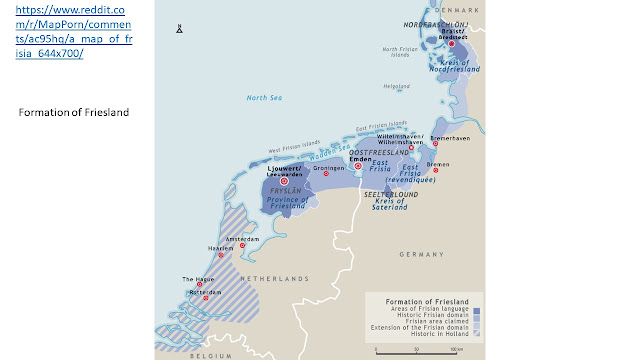
Having found a likely location for the birthplace of Hendrick (Niewenhuys) which lies in present day Germany albeit a little square block of land that sticks into the Dutch countryside; I have not yet found a map that shows anything different with regard to this small area of land. Since he did move to Amsterdam and was prosperous there as far as is known, one assumes he was likely Dutch. His yDNA places him in the Frisian ethnic group (i.e. living within 100 km of Amsterdam). What does within 100 km of Amsterdam look like?

Cities  within 98- 100 km of Amsterdam - Boxtel, Den Helder, Brielle, Druten, Waalwijk, Arnheim, Heudsen, Oud-Beijerland and interesting enough all of these cities are in The Netherlands. What can I learn about the Frisians? They lived along the seacoast and were there before the Roman Empire expanded. As the North Sea rose towards the end of the first millenium the Frisians moved inland, although this area again became populated after diking and the people were called Frisians, there seems to be some doubt that this was a large return of the earlier population.

Interestingly you can clearly see on this map (red arrow) the square block of land on the eastern border of The Netherlands where this small village was located that the Betrothal Notice stated as being the birthplace of Hendrick Hendrixsz. These borders were pretty fluid in this time frame and it was more of a matter of who controlled the land. I still have no idea on that other than the pieces from a book and the London Gazette discussing a war in 1674 wherein the Dutch controlled that particular town quoted earlier in this newsletter. 

Edward tested his DNA at 23 and Me, Ancestry, FT DNA, Living DNA and it was uploaded to My Heritage. He also tested at Ethnoancestry and Sorenson. At 23 and Me Edward is said to belong to Z-326 and share an ancient ancestor (10,000 years ago) with King Louis XVI.

Ethnicity at tested DNA sites:

23 and Me Ancestry FT DNA Living DNA My Heritage

French & German 87.9% 28.6%

Germanic 43% 40.8%

England/N.Europe 38% 71.4%

Scandinavian 7.7% 29%

Great Britain 53%

British & Irish 2% 59.1%

Sweden & Denmark 8%

Norway 7%

Scotland 2%

Wales 2%

Central Europe 4%

Basque 6%

Looking at Edward’s eight great grandparents – Paternal: great paternal grandfather (Kipp - Dutch); great paternal grandmother (Force - English/French); great maternal grandfather (Schultz - north east Germany); great maternal grandmother (Nieman - north east Germany); Maternal - great paternal grandfather (Link - USA-German); great paternal grandmother (Rathbun - USA-English); great maternal grandfather (Allen - USA-Dutch); great maternal grandmother (Parlee - USA-French Huguenot). Edward does have some Loyalist ancestry with his Link, Allen and Parlee lines and a number of the further back ancestors in the Allen and Parlee lines were English Dissenters early to the American Colonies. The Link came in the 1740s to the Mohawk Valley and again married descendants of English Dissenters. So depending on the data sets used Edward's ethnicity results are going to be coloured by these early groups to the American Colonies. Living DNA, My Heritage, FT DNA and Ancestry do tend to show a higher percentage of English than 23 and Me. When I do a manual percentage analysis at the 5x great grandparent level I obtain 30% German, 30% Dutch, 15% French, 10% English, 5% Scandinavian and 5% Scot. 

I will discuss the actual yDNA study at FT DNA in the next newsletter within the bounds of confidentiality requested by FT DNA. 

8. Next Issue

The next issue is planned for the 1st of May 2022. Anyone wishing to submit an article/letter to the editor please send to Elizabeth Kipp (kippeeb@rogers.com). 

Sunday, January 30, 2022

The Kipp-Kip Family Newsletter

 I have completed the Kipp-Kip Family Newsletter and a link will be published on the Kip-Kipp yDNA study at FT DNA on the 1st of February. 

Saturday, January 8, 2022

Continuing with the political times in the 1600s in The Netherlands

 I am into the political times of the day in The Netherlands in this time period in my thinking. It was a time of unrest as the Holy Roman Empire slowly dissolved and became the countries that we know today. France was dominating the area although the article that I found showed the Prince-Bishop of Munster (Christoph Bernhard von Galen) up against  Lieutenant General (Carl von) Rabenhaupt. Rabenhaupt who was recruited by the Dutch in 1671. Getting back to the 1600s though which is the real interest time period  and it comes at the end of a century or more of economic prosperity for the Low Countries as they are known (The Netherlands, Belgium and Luxembourg). The last years of the 1500s and the early years of the 1600s are marred by a series of conflicts with the Spanish Hapsburg rulers. In 1581, this area became an independent state known as the States General or the Dutch Republic. In 1609 the Twelve Years' Truce brought the Dutch Republic into its Golden Age which lasted from 1609 - 1713 and saw the Dutch Republic ranked as one of the most powerful and influential in the world. This was the time of emigration to the Americas and the Dutch were at the forefront establishing New Holland (large parts of present day New York State) and New Amsterdam (now New York City). It can be understood that many of the Dutch were interested in emigrating and Hendrick Hendricksen Kip with his wife and six children were amongst those who did. 

Having found a likely location for the birthplace of Hendrick which lies in present day Germany albeit a little square block of land that sticks into the Dutch countryside; I have not yet found a map that shows anything different with regard to this small area of land. Since he did move to Amsterdam and was prosperous there as far as is known, one assumes he was likely Dutch. His yDNA places him in the Frisian ethnic group (i.e. living within 100 km of Amsterdam). What does within 100 km of Amsterdam look like?

Cities  within 98- 100 km of Amsterdam - Boxtel, Den Helder, Brielle, Druten, Waalwijk, Arnheim, Heudsen, Oud-Beijerland and interesting enough all of these cities are in The Netherlands. I sort of rest my case. What can I learn about the Frisians? They lived along the seacoast and were there before the Roman Empire expanded. As the North Sea rose towards the end of the first millenium the Frisians moved inland, although this area again became populated after diking and the people were called Frisians, there seems to be some doubt that this was a large return of the earlier population.


Interestingly you can clearly see on this map the square block of land on the eastern border of The Netherlands where this small village was located that the Betrothal Notice stated as being the birthplace of Hendrick Hendrixsz. These borders were pretty fluid in this time frame and it was more of a matter of who controlled the land. I still have no idea on that other than the pieces from a book and the London Gazette discussing a war in 1674 wherein the Dutch controlled that particular town. 

Edward tested his DNA at 23 and Me, Ancestry, FT DNA, Living DNA and it was uploaded to My Heritage. He also tested at Ethnoancestry and Sorenson. At 23 and Me Edward is said to belong to Z-326 and share an ancient ancestor (10,000 years ago) with King Louis XVI.

Ethnicity at tested DNA sites:

23 and Me

99.9% European

87.9% French and German (this includes the area in the border area above where the town of Niewenhuys was located)

7.7% Scandinavian

2% British and Irish

Ancestry

43% Germanic Europe

38% England and Northwestern Europe

8% Sweden and Denmark

7% Norway

2% Wales

2% Scotland

FT DNA

100% European

53% England, Wales and Scotland 

29% Scandinavia

4% Central Europe

6% Basque

3% Greece and Balkans

2% Italian Peninsula

3% Magyar

Living DNA

59.1% Great Britain and Ireland

40.8 Germanic

My Heritage (Ancestry results uploaded)

71.4% English

28.6% North and West European

I always find the Ethnicity Results interesting for Edward with only 23 and Me capturing what we would calculate as his likely Ethnicity. Looking at his eight great grandparents (two came directly from Germany), paternal great paternal grandfather (Kipp - Dutch); paternal great paternal grandmother (Force - English/French); paternal great maternal grandfather (Schultz - north east Germany); paternal great maternal grandmother (Nieman - north east Germany); maternal great paternal grandfather (Link - USA-German); maternal great maternal grandmother (Rathbun - USA-English); maternal great maternal grandfather (Allen - USA-Dutch); maternal great maternal grandmother (Parlee - USA-French Huguenot). Ed does have some Loyalist ancestry with his Link, Allen and Parlee lines and a number of the further back ancestors in the Allen and Parlee lines were English Dissenters early to the American Colonies. The Link came in the 1740s to the Mohawk Valley and again married descendants of English Dissenters. So depending on the data sets used Edward's ethnicity results are going to be coloured by these early groups to the American Colonies. Living DNA, My Heritage, FT DNA and Ancestry do tend to show a higher percentage of English than 23 and Me. When I do a manual county at the 5x great grandparent level I obtain 30% German, 30% Dutch, 15% French, 10% English, 5% Scandinavian and 5% Scot. One addition that could be made to Ethnicity Results would be an idea of what time period one is looking at and 23 and Me does do that.